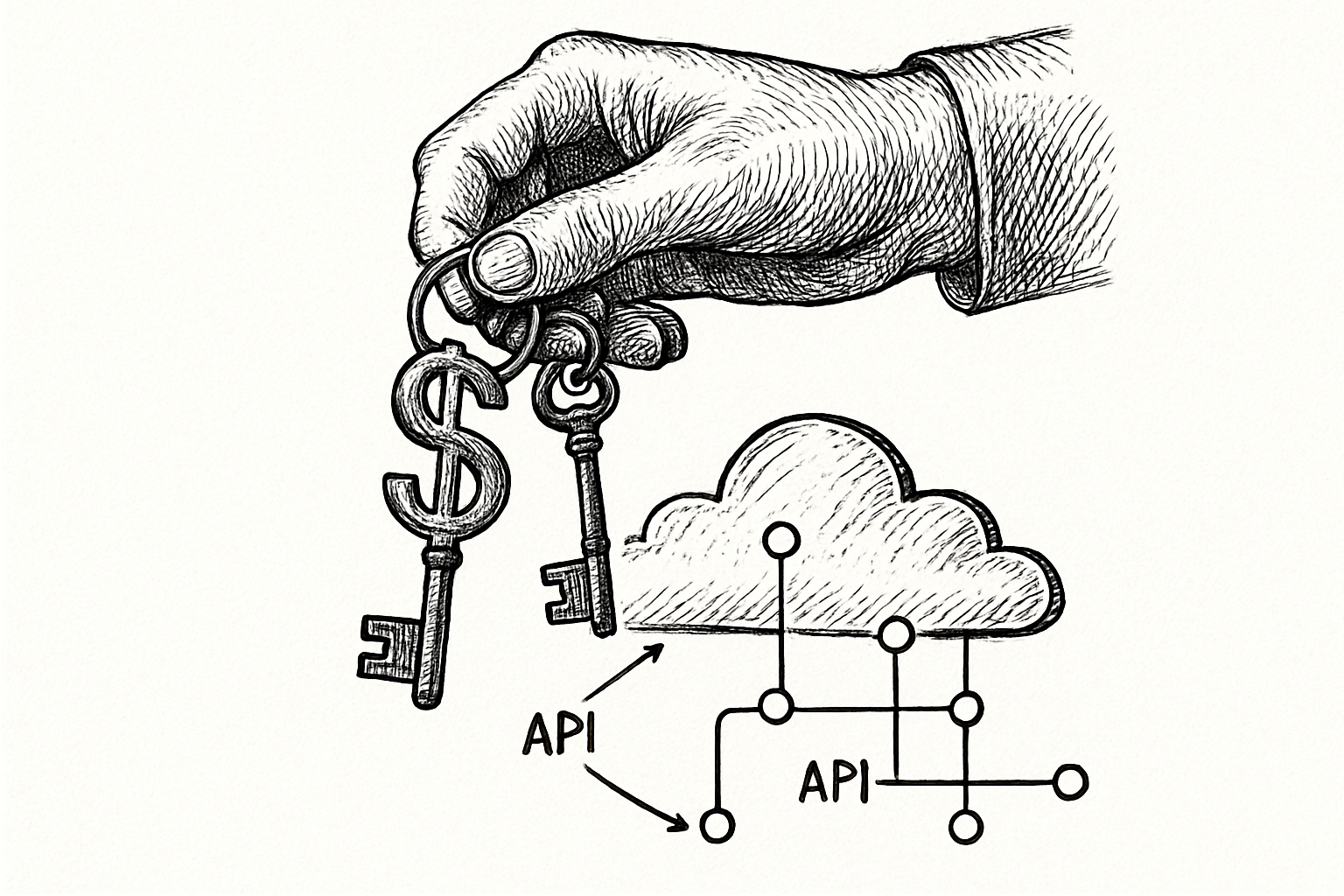
How to add monetization to AWS API Gateway
You built your API on AWS API Gateway. Good choice — it's reliable, scales without drama, and it's already wired into your infrastructure. But now you want to monetize it: charge developers for access, track usage by customer, manage subscriptions, maybe build a partner portal. And you've quickly discovered that API Gateway itself won't get you there.
That's not a knock on AWS. API Gateway does what it says on the tin: it routes requests, manages security, and controls throughput. Billing, partner onboarding, and subscription management live somewhere else. This guide covers your options.
What AWS API Gateway does (and doesn't do)
AWS API Gateway handles the infrastructure layer well:
- Routing requests to your backend
- Rate limiting and throttling via usage plans
- Authentication with API keys and IAM
- Response caching
What it doesn't include:
- Payment processing or billing
- Subscription management (free trial → paid plan → renewal)
- A developer portal for external partners
- Partner onboarding workflows with approvals and access control
- Usage revenue reporting for finance and leadership
The gap between "API Gateway manages my traffic" and "I have a working monetization model" is larger than most teams expect. Three paths will take you there.
Option 1: Use AWS's native billing tools
API Gateway does offer some monetization capabilities:
- Usage plans let you set quotas and throttle limits per API key
- AWS Marketplace lets you list your API as a SaaS product for AWS buyers
- Lambda-based billing works if your entire stack lives inside AWS
These are a reasonable starting point if your needs are simple. Usage plans are good for rate limiting, but they're blunt instruments — they weren't built for flexible pricing models. You can't do graduated tiers, per-unit billing, or contract-based pricing natively.
AWS Marketplace is useful if you're selling to AWS customers specifically. It works well for that channel, but it's not a developer portal — you can't brand it, customize the onboarding flow, or manage a partner ecosystem through it.
If your monetization needs are minimal and your buyers are almost all AWS-native companies, this path is worth exploring. If you need more flexibility, you'll outgrow it quickly.
Option 2: Build it yourself
Some teams try to close the gap in-house. The logic is sound: you already have AWS expertise, your engineers know the stack, and it feels like it should be a small project.
In practice, it isn't. A homegrown monetization layer means:
- Integrating a payment processor (Stripe, Zuora, or similar)
- Building a subscription portal developers can actually use
- Writing logic for usage tracking and metered billing
- Enforcing plan limits and entitlements at the gateway level
- Creating an onboarding flow for new API partners
- Maintaining all of it as your API evolves
Engineering hours add up fast. Your team's time is finite — every sprint spent on billing infrastructure is a sprint not spent on the product. And the maintenance burden compounds: every pricing change, plan addition, or new partner requirement touches the custom code.
Building it yourself makes sense if you have very unusual requirements, a large platform engineering team, and low time pressure. For most API businesses, it's the most expensive path. For a detailed breakdown, see API portal: build vs. buy.
Option 3: Add a purpose-built monetization layer
This is where tools like Apiable come in.
Apiable connects to your existing API Gateway — including AWS API Gateway — and adds the full monetization and partner onboarding stack on top. You keep using AWS for routing, security, and scaling. Apiable handles everything your gateway doesn't.
Flexible pricing models. Set up the plans your business actually needs: flat rate, per-unit, volume-based, graduated tiers, or contract-based pricing. Change pricing without touching your API or your gateway configuration. If you want to charge on consumption, you can set up usage-based billing that meters each partner's calls and bills them accordingly.
Subscription lifecycle management. Free trials, upgrades, plan changes, and cancellations — all tracked, all automated. When a developer's trial expires, their access updates automatically.
A branded developer portal. External developers and partners get a self-serve portal where they can sign up, browse your API docs, select a plan, and start integrating. No back-and-forth emails, no manual provisioning steps.
Partner onboarding with approvals and RBAC. Control who gets access to which APIs. Set up approval workflows for new partner applications. Assign roles and permissions per company or team. Apiable is built for organizations managing external partners — not just public, open-access APIs.
Usage tracking and revenue reporting. See who's using your API, what they're consuming, and what it's generating in revenue. On AWS, this starts when you enable usage logs on AWS API Gateway so Apiable can attribute every call to a partner and a plan. Share reports with finance, product, and leadership without exporting to spreadsheets.
Payment processing. Connect your existing payment provider and collect revenue directly from your API subscriptions.
How the AWS API Gateway integration works
Apiable syncs with AWS API Gateway through your API specs. Your existing gateway configuration stays in place — Apiable reads your OpenAPI specs and surfaces corresponding products in the developer portal. When a developer subscribes to a plan, Apiable provisions their API key in your gateway automatically. The step-by-step setup, including the IAM permissions Apiable needs, is documented in connecting AWS API Gateway to Apiable.
The integration is designed to be non-disruptive. You don't migrate off AWS. You add the layer that AWS doesn't provide, on top of the infrastructure you've already built.
Full integration details are at apiable.io/aws/.
Which option is right for you?
| Your situation | Best path |
|---|---|
| Simple rate limiting, no billing needed | AWS usage plans |
| Selling exclusively to AWS buyers, simple pricing | AWS Marketplace |
| Flexible pricing + developer portal + partner onboarding | Purpose-built layer (Apiable) |
| Highly custom requirements, large platform team, no time pressure | Build it yourself |
If you're building an API business with external partners — and you want a faster path than your engineering team can build — a purpose-built monetization layer is worth evaluating. For the full picture on pricing models, see what is API monetization. For the revenue case to bring to leadership, see how to build a business case for API monetization.
Get started
Apiable connects to AWS API Gateway in a few steps. See the AWS integration page for the technical overview, the architecture overview for how the layers fit together, or book a demo to see how it works with your specific setup.