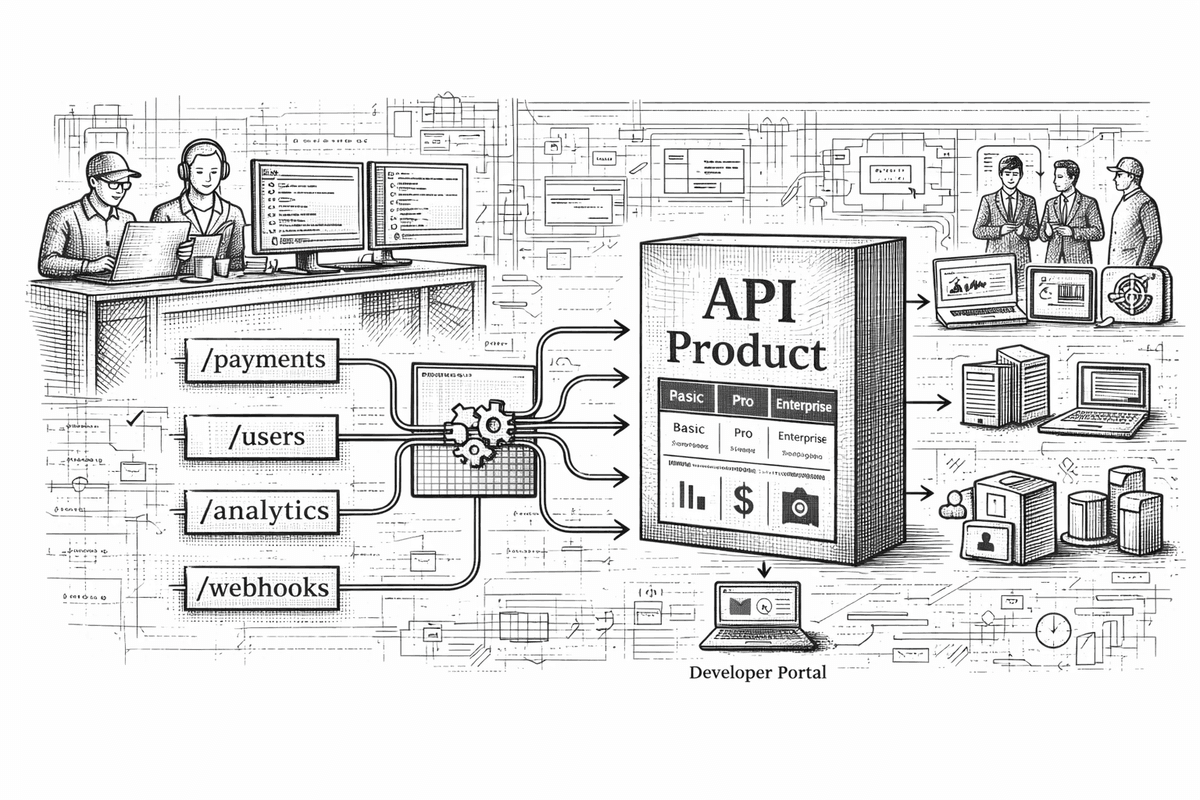
API as a Product: The Complete Guide to API Productization
Most companies treat their APIs like plumbing. They route requests, move data, and get the job done. Nobody thinks much about them until something breaks.
The companies making money from their APIs see them differently. They treat APIs as products, with real packaging, real pricing, and a real onboarding experience. The API becomes something a partner can discover, subscribe to, and start using without calling your support team.
That shift in thinking — from plumbing to product — is what this guide is about.
What Does "API as a Product" Mean?
An API product is an API packaged with documentation, pricing, support, and onboarding, designed to be consumed by external partners, not just internal teams.
It's the difference between "here's an endpoint, good luck" and "here's a product you can subscribe to, with clear pricing, sandbox access, and documentation that actually explains what each call returns."
The underlying API might be identical. What changes is everything around it: how it's discovered, how access is granted, how usage is measured, and how value is captured. Product thinking applied to APIs means answering the same questions any product team would ask:
- Who is this for?
- What problem does it solve for them?
- How do they get started?
- What does it cost?
- How do we know if it's working?
When your API can answer all five questions clearly, it's a product. Until then, it's infrastructure.
API as Infrastructure vs. API as a Product
The clearest way to understand the distinction is to see them side by side. Most teams start on the left. The goal is to move right.
| Dimension | API as Infrastructure | API as a Product |
|---|---|---|
| Primary audience | Internal developers | External partners and customers |
| Documentation | Technical specs for internal use | Partner-facing docs with tutorials, examples, and error handling |
| Pricing | Free (absorbed as a cost) | Defined pricing tiers or usage-based billing |
| Onboarding | Manual, coordinated by your team | Self-service: partners sign up, get credentials, and start building |
| Success metrics | Uptime, latency, error rates | Adoption rate, partner activation time, revenue generated |
| Ownership | Engineering team | API product manager or partner team |
The shift from left to right is not primarily a technical change. It's a commercial and operational one. Your API gateway doesn't need to change. Your pricing model, your portal, and your onboarding process do.
The API Productization Framework
Turning an API into a product is not one decision. It's a sequence of decisions. Here's a five-step framework that works whether you're starting from scratch or formalizing an existing API program.
Step 1: Define your audience
Before packaging anything, you need to know who you're packaging it for. "External developers" is not specific enough.
Ask: what type of partner is this API for? Technology partners integrating with your platform? Independent software vendors building on top of your data? Enterprise customers who need a higher-tier integration?
Different audiences need different things. An ISV building a commercial product needs pricing predictability and a sandbox. An enterprise partner needs contract-based access and approval workflows. A casual developer needs a free tier and fast self-service.
Get specific about who you're building for before you build anything.
Step 2: Package your APIs into products
Most APIs are not sold one endpoint at a time. They're bundled into products that represent a use case or a value outcome.
A payment provider might offer a "Payments API" that includes authorization, refunds, and webhooks. A healthcare platform might offer a "Patient Data API" that groups patient records, appointment history, and clinical notes. The individual endpoints are the ingredients. The API product is the meal.
Packaging means grouping related endpoints, then creating plans around them. A plan defines what a subscriber gets: which endpoints, what rate limits, what pricing. You might have a Free plan (limited calls, sandbox only), a Growth plan (10,000 calls per month, production access), and an Enterprise plan (custom limits, SLA, dedicated support).
Apiable's API product catalog lets you define products, attach multiple plans, set usage limits per plan, and connect them directly to your billing and gateway configuration.
Step 3: Set pricing and monetization
Pricing is the most avoided part of API productization. Most teams defer it indefinitely, defaulting to "we'll figure it out later." By then, partners have come to expect free access, and repricing becomes a negotiation.
Here are the key pricing models worth understanding:
- Flat-rate: A fixed monthly fee for API access. Predictable for both sides. Works when usage is relatively uniform.
- Usage-based (per-unit): Partners pay per API call, per record, or per data point processed. Aligns cost with value. Scales with the partner's growth.
- Tiered: Different prices apply to different usage bands. Common in SaaS. "First 1,000 calls at $0.01, next 10,000 at $0.008."
- Volume: A single price applies to the entire usage based on total volume. Encourages higher usage with lower per-unit cost at scale.
- Flat-rate plus overage: A base fee covers a set number of calls, and overages are charged at a per-unit rate. Predictable for most partners, with upside for your high-usage segments.
- Credit pack with burndown: Partners purchase a block of credits upfront and spend them down over time. Works well for event-driven APIs or unpredictable usage patterns.
Which model is right depends on your API's value delivery pattern and your partners' planning preferences. Most platforms should offer at least two options. Read more about these models in our guide to API monetization.
Step 4: Build the onboarding experience
Pricing without a good onboarding experience is a broken product. If a partner has to email your team to get credentials, wait three days, and fill out a form that goes to someone's inbox, they will churn or not start at all.
Self-service is the standard your partners compare you against. Stripe doesn't require a call to get started. Twilio doesn't. The bar is set, and your partners know it.
A good API onboarding experience has four parts:
- Discovery: A partner can find your API products, understand what they do, and choose the right plan without talking to anyone.
- Registration: Account creation, identity verification (if required), and terms of service acceptance are handled in a flow, not over email.
- Credentials: API keys or OAuth credentials are generated and delivered immediately after subscription. Not "within 2-3 business days."
- Sandbox: Partners can test against real endpoints with test data before going to production. This reduces support tickets and accelerates their time to first real call.
If you need to add approval steps (for compliance, legal, or business reasons), those should be embedded in the flow. A partner submits their application. You approve or reject it. They get notified. The whole process is tracked, not managed in someone's email thread.
Step 5: Measure and iterate
An API product without analytics is a product flying blind. You can't improve what you can't see.
The metrics that matter for an API product fall into three categories:
Adoption metrics: How many partners have subscribed to each product? What's the time from registration to first API call? Where are partners dropping off during onboarding?
Usage metrics: Which endpoints are used most? Which partners are your highest-volume consumers? Are partners staying within their plan limits or hitting overages?
Revenue metrics: What's the monthly recurring revenue per product? What's the average revenue per partner? Which plans are growing fastest?
These numbers tell you what to build next, which plans to adjust, and which partners need attention. Without them, you're making product decisions based on guesswork.
What Makes a Great API Product?
Five qualities separate API products that partners actually adopt from ones that sit unused.
Great API products are discoverable. Partners can find them through a portal or catalog without needing an introduction from your sales team. The product name, description, and use cases are written for the partner, not for your internal wiki.
They have documentation worth reading. Not a raw OpenAPI spec. Actual guides that explain what the API does, how to authenticate, what each parameter means, and what happens when things go wrong. With code examples in the languages your partners use.
They have pricing that's clear upfront. No "contact us for pricing" on every plan. Partners can see what they'll pay, compare plans, and make a decision without a conversation. Pricing clarity builds trust. Opacity builds friction.
They offer self-service onboarding. A partner can go from "I found this" to "I made my first call" without talking to anyone on your team. This is the single biggest lever on partner activation rate.
They give partners usage visibility. Partners can see how many calls they've made, how close they are to their limit, and what their bill will look like before it arrives. This prevents billing surprises and reduces support volume.
If your API product has all five, it will outperform one that doesn't, regardless of how good the underlying API is.
API Product Management: Who Owns It?
API product management is an emerging discipline. Most organizations don't have an API product manager yet. They should.
The API product manager owns the commercial success of the API program. This is distinct from the engineering lead who owns the API technically. Both roles are necessary. They're not the same job.
An API product manager is responsible for:
- Defining which APIs to productize and for which audience
- Setting pricing strategy and plan structure
- Owning the partner onboarding experience end to end
- Tracking adoption, activation, and revenue metrics
- Working with engineering to prioritize changes based on partner feedback
- Reporting to leadership on the business performance of the API program
The metrics this role is measured on include partner activation rate (what percentage of subscribers make a first API call within 7 days), time to first call, monthly active partners, and revenue generated per product.
If nobody in your organization owns these numbers today, that's a gap. API programs that treat these as engineering metrics tend to stay cost centers. Ones that treat them as product and business metrics tend to become revenue contributors.
Key Takeaways
- An API product is an API packaged with pricing, documentation, onboarding, and billing, designed for external consumption.
- Infrastructure APIs serve internal teams. Product APIs serve external partners and capture commercial value.
- The API productization framework has five steps: define your audience, package APIs into products, set pricing, build self-service onboarding, and measure adoption and revenue.
- The six API pricing models are flat-rate, usage-based, tiered, volume, flat-rate plus overage, and credit pack with burndown.
- Great API products are discoverable, well-documented, clearly priced, self-service to onboard, and give partners usage visibility.
- API product management is a distinct role from API engineering. Someone needs to own the commercial success of the API program.
- The companies that win treat their APIs as strategic assets, not technical infrastructure.
Ready to Turn Your APIs into Products?
Apiable is built specifically for teams that want to productize their APIs without spending six months on custom development.
You get an API product catalog where you can package APIs into plans with pricing, usage limits, and documentation. You get a self-service partner portal that handles registration, approval flows, credential provisioning, and sandbox access. You get flexible monetization with multiple pricing models (flat-rate, per-unit, volume, graduated, flat-rate plus overage, contract-based, and credit burndown) connected to Stripe. And you get usage and revenue analytics so you can see what's working.
Most teams are live within 3-4 weeks.
See how API products work in Apiable or book a demo and we'll walk through it with your specific APIs and partner use case.
Related reading: